
What Makes Stainless Steel Wire Mesh the Smart Choice for Tapioca Starch Filtration on Vibratory Screens - MAISHI
What Makes Stainless Steel Wire Mesh the Smart Choice for Tapioca Starch Filtration on Vibratory Screens
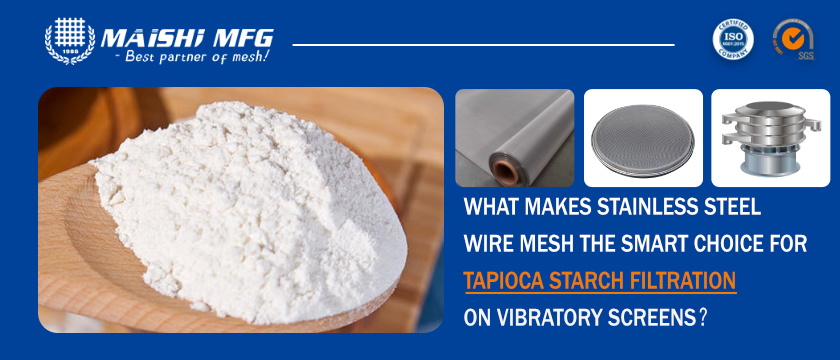
From boba tea to biodegradable packaging, tapioca starch gives everyday products their smooth mouthfeel and clean melt. Before those white granules reach the food factory or bioplastic plant, however, they must be separated from fibre, husks, and oversize agglomerates—a task that places extreme demands on any filter medium. MAISHI stainless steel wire mesh working with vibratory screens answers those demands with a combination of precision, hygiene, and long service life.
Advantages of MAISHI Stainless Steel Wire Mesh:
– Ultra-smooth surface that fibres cannot anchor to.
– High-tensile wires resist the constant flexing of vibratory decks
– A wide variety of mesh counts and opening sizes can be used to construct a progressive scalping/de-dust cascade
– Thermal-shock resistant—steam cleaning does not distort the cloth
– Static dissipation—metal mesh prevents starch-dust build-up
Advantages of Vibratory Screens:
– High-frequency vibration breaks up starch lumps and keeps apertures clear, boosting throughput
– Self-supporting mesh cuts screen-change frequency and downtime
– Quick-clamp design allows a full mesh swap in minutes, so production restarts fast
MAISHI’s stainless steel wire mesh is available in various specifications and keeps 1 m, 1.22 m, 1.5 m and 1.8 m wide rolls in 20–120 mesh, which are ideal for filtering tapioca starch. Additionally, we also offer other mesh counts and widths to suit customers’ specific needs.
Welcome to the inquiry MAISHI team to get more technical support and explore how our stainless steel wire mesh can enhance your tapioca starch filtration experience.
Tags
#stainlesssteelwiremesh, #tapiocastarchfiltration, #vibratoryscreenmesh, #foodgrademesh, #sustainablefiltration

Leave A Comment