
The Role of Filter Mesh in Protecting Industrial Processing Systems - MAISHI
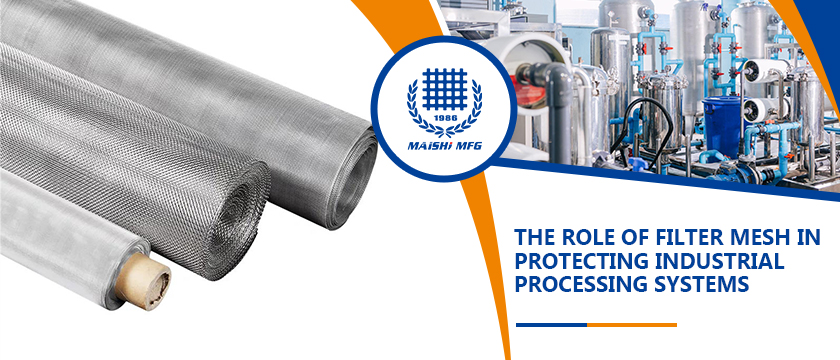
The Role of Filter Mesh in Protecting Industrial Processing Systems
In industrial production, filtration is not only about removing unwanted particles. It also plays an important role in protecting equipment, maintaining product consistency and supporting smooth production operations. From water treatment and food processing to chemical manufacturing, filter mesh is an essential component in many separation systems.
During production, suspended solids, impurities and unwanted particles can enter liquids or processing materials. If these particles are not properly separated, they may accumulate in pipelines, affect pumps and valves, or influence the quality of finished products. A suitable filter mesh helps control particle separation and supports more reliable operation throughout the production process.
MAISHI provides industrial filter mesh in stainless steel, polyester, nylon, polypropylene (PP) and polylactic acid (PLA), offering different material options for various filtration requirements.
How Filter Mesh Supports Industrial Production
Filter mesh is commonly installed in filtration equipment, liquid processing systems and separation devices. Its main function is to retain particles while allowing the required liquid or material to pass through.
In industrial water treatment, filter mesh can help remove suspended solids before water enters subsequent treatment stages. In food and beverage production, it can be used to separate unwanted solid particles from liquids or ingredients. In chemical processing, suitable mesh materials help support separation processes under specific operating conditions.
For example, in a liquid processing line, a mesh filter installed before downstream equipment can help capture larger unwanted particles and reduce the amount of solid material entering subsequent components. The filtration result depends on the mesh opening, material properties and operating conditions.
For applications involving multiple particle sizes, different filtration stages may be used. Coarser mesh can retain larger particles first, while finer mesh can provide additional separation where required. This approach helps balance filtration accuracy and flow capacity.
Material Performance for Different Filtration Requirements
The material of filter mesh influences its mechanical properties, durability and compatibility with the filtration medium. Different production environments therefore require different material considerations.
Stainless Steel Filter Mesh
MAISHI supplies SS304 and SS316 stainless steel filter mesh for industrial filtration applications. Stainless steel offers mechanical strength, durability and resistance to corrosion under suitable operating conditions. SS304 is commonly considered for general industrial filtration, while SS316 provides improved resistance to chloride-containing environments and certain corrosive media.
It can be used in water treatment, chemical processing, oil filtration and industrial separation systems.
Polyester Filter Mesh
Polyester mesh offers good dimensional stability and consistent openings. It is suitable for various liquid filtration, food processing and industrial separation applications where stable mesh structure is important.
Nylon Filter Mesh
Nylon mesh provides flexibility, elasticity and abrasion resistance. It is an option for filtration processes involving repeated handling, material contact or applications requiring flexible mesh structures.
PP and PLA Filter Mesh
Polypropylene and polylactic acid mesh provide additional material choices for specific filtration requirements. Their suitability depends on the filtration medium, temperature, chemical compatibility and intended operating environment.
Selecting the appropriate material helps ensure that the mesh performs as expected throughout its service life.
Understanding the Specifications Behind Filtration Performance
The effectiveness of filter mesh depends on more than the material itself. Several technical parameters influence particle retention, flow performance and mechanical durability.
Mesh Count: Indicates the number of openings or threads per unit of length and helps describe mesh density.
Micron Rating: Defines the intended filtration fineness where a verified rating is available.
Opening Size: Determines the actual space available for particles and liquid to pass through.
Wire or Thread Diameter: Influences the strength and structure of the mesh.
Open Area: Represents the proportion of open space available for flow.
Thickness: Helps describe the physical structure of the mesh.
These parameters work together. A smaller opening may improve the retention of fine particles, but it can also increase flow resistance or clogging risk when the liquid contains a high concentration of solids.
For example, a wastewater treatment application with a high suspended-solids load may require a mesh specification that balances particle retention with cleaning frequency. A different application involving fine liquid separation may require smaller openings and a suitable open area to maintain the desired flow.
Maintenance and Operating Conditions Matter
Even a properly selected filter mesh requires suitable maintenance and operating conditions.
Particle accumulation gradually reduces the available open area and may increase pressure drop across the filter. Depending on the filtration system, this can lead to reduced flow, more frequent cleaning or additional maintenance requirements.
Before choosing a filter mesh, buyers should consider the following factors:
1、Filtration Medium: Identify whether the mesh will handle water, oil, chemicals, food liquids or other materials.
2、Particle Characteristics: Understand particle size, concentration and whether particles are likely to accumulate or block openings.
3、Operating Conditions: Evaluate working temperature, pressure and chemical exposure.
4、Cleaning Requirements: Consider whether the mesh will be washed, backwashed or replaced periodically.
5、Service Life: Balance filtration requirements with mechanical durability and maintenance costs.
Testing the selected mesh under actual working conditions is recommended, particularly for demanding industrial applications.
MAISHI Filter Mesh Solutions for Industrial Applications
Since 1986, MAISHI has focused on wire mesh manufacturing, providing different mesh materials and specifications for customers worldwide.
Our filter mesh product range includes stainless steel, polyester, nylon, PP and PLA options for water treatment, food and beverage filtration, chemical processing, oil filtration and industrial separation.
From material selection to weaving and finished product inspection, we focus on uniform mesh openings, consistent specifications and customized manufacturing solutions.
Whether you are an industrial equipment manufacturer, filtration system supplier or end user, MAISHI can provide different filter mesh options according to your application requirements.
Looking for filter mesh for your industrial filtration system?
Contact MAISHI to discuss your filtration medium, required opening size, material and operating conditions.

Leave A Comment