How Welded Wire Mesh Specifications Affect Strength and Application Performance - MAISHI
How Welded Wire Mesh Specifications Affect Strength and Application Performance
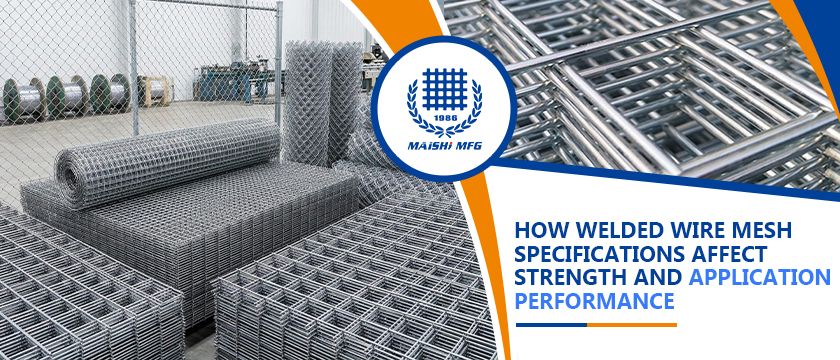
Welded wire mesh is widely used in construction, fencing, industrial protection and agricultural applications. Although it may appear to be a simple grid structure, its performance depends on several important factors, including wire diameter, mesh opening, material and surface treatment. Understanding these specifications helps buyers select suitable welded wire mesh for different working conditions and structural requirements.
MAISHI manufactures welded wire mesh in rolls and panels, offering different materials, dimensions and configurations for industrial and commercial applications. Our product range includes galvanized welded wire mesh, stainless steel welded mesh, PVC-coated mesh and reinforcing welded mesh.
Wire Diameter and Mesh Opening: Finding the Right Balance
Wire diameter and mesh opening are two fundamental specifications that influence the strength and functionality of welded wire mesh.
A thicker wire generally provides greater resistance to bending and mechanical loads, while smaller mesh openings create a denser grid structure. However, the ideal combination depends on the intended application rather than simply choosing the thickest wire or smallest opening.
For example, machine guards and industrial protective barriers may require relatively strong wires and openings designed to restrict access. Agricultural enclosures may use different opening configurations according to the size and type of animals being contained.
MAISHI’s welded wire mesh catalogue covers opening sizes from 1/4″ × 1/4″ (6.4 × 6.4 mm) to 6″ × 8″ (152.4 × 203.2 mm), with wire diameters ranging from 0.50 mm to 10.00 mm across the listed specifications.
Roll and panel dimensions can also be customized according to project requirements. Standard roll lengths include 50 ft and 100 ft, while standard panel lengths range from 4 ft to 10 ft.
Material and Surface Treatment for Different Environments
Material selection is another important consideration when purchasing welded wire mesh. Different materials and coatings provide different characteristics depending on environmental exposure and application requirements.
MAISHI offers several material and surface treatment options:
Electro Galvanized Steel: Provides a zinc coating for general corrosion protection.
Hot-Dip Galvanized Steel: Offers a thicker zinc coating option for applications requiring enhanced corrosion protection.
Zn-Al (Galfan) Coated Steel: Provides an alternative metallic coating option.
PVC and PE Coated Mesh: Adds a protective polymer coating and offers different surface finishes.
Stainless Steel Mesh: Suitable for applications requiring corrosion resistance and durability.
Black Iron and Other Alloy Materials: Available for different manufacturing and project requirements.
The timing of galvanizing also matters. Galvanizing after welding provides zinc coverage over the welded intersections, helping reduce the risk of rust developing at weld points compared with galvanizing before welding. This can be an important consideration for outdoor fencing and other applications exposed to moisture.
For example, a customer installing outdoor fencing may consider hot-dip galvanized-after-welding mesh for improved protection at welded intersections. For decorative garden fencing, PVC-coated mesh may be preferred for its additional coating and available color options.
Matching Welded Wire Mesh to Practical Applications
Different industries require different welded mesh structures.
In construction, reinforcing welded mesh is used in concrete structures, floor slabs and brick walls. Manufactured from high-tensile-strength steel wires, it is available in square and rectangular configurations to support reinforcement requirements and simplify installation.
MAISHI supplies reinforcing welded mesh specifications associated with several regional standards, including AS/NZS 4671, BS4483 and DIN488. These specifications cover different wire diameters, spacing arrangements and sheet dimensions.
For industrial applications, welded wire mesh rolls and panels can be used in machine protection, storage cages and equipment enclosures. Suitable wire diameter and opening dimensions help meet the requirements of different structures.
In agriculture, livestock welded wire panels are designed for animal enclosures. Different opening arrangements are available for hogs, cattle, sheep, goats and horses, according to the product configurations listed in our catalogue.
These examples demonstrate why mesh specifications should be selected according to the intended application, loading requirements and installation environment.
Production Quality and Manufacturing Consistency
Reliable welded wire mesh depends not only on material selection but also on consistent manufacturing.
MAISHI follows a controlled production process covering raw material inspection, wire straightening, cutting, welding, final inspection, packing and loading.
Our manufacturing facilities operate 8 large-scale automatic multi-spot welding machines and 7 medium-sized multi-spot welding machines. The catalogue indicates a monthly production capacity of approximately 150–300 tons, supporting different order volumes and product specifications.
Consistent wire spacing, accurate dimensions and reliable welded intersections are important considerations throughout production. Final inspection helps identify dimensional variations and visible welding defects before products are packed and delivered.
With different material options, opening sizes, wire diameters and surface treatments, MAISHI can provide welded wire mesh in customized configurations to meet different project requirements.
Choosing a Suitable Welded Wire Mesh Supplier
Before selecting welded wire mesh, buyers should evaluate several factors: required wire diameter, mesh opening, material, coating type, panel or roll dimensions and the environment in which the mesh will be installed.
For example, a construction project requiring concrete reinforcement will have different specifications from an agricultural enclosure or an industrial machine guard. Providing these details helps manufacturers recommend a more suitable product configuration.
Since 1986, MAISHI has focused on wire mesh manufacturing and customized mesh solutions for customers worldwide. From standard welded wire mesh rolls and panels to reinforcing mesh and welded mesh fencing, we work to provide consistent specifications and reliable manufacturing support.
Looking for welded wire mesh for your next project?
Contact MAISHI to discuss your required wire diameter, mesh opening, material and surface treatment.

Leave A Comment